

 See My Latest Article on HelloNation
Is DIY Paintless Dent Repair worth trying?
For a small, shallow dent with intact paint, DIY paintless dent repair can be worth attempting if the goal is to improve the appearance rather than guarantee a flawless finish. The risk is usually manageable when the dent is accessible, but mistakes can create cracked paint, stretched metal, sharp high spots, or a repair that looks worse under changing light.
Paintless dent repair, often called PDR, reshapes a vehicle’s metal from behind or through the use of controlled pulling. It does not involve sanding, filling, repainting, or replacing the panel. That makes the process different from using body filler or touch-up paint, even though all of these methods may be used to address visible damage.
For residents of Apex, NC, minor dents can result from parking-lot contact, falling branches, bicycle or sports equipment impacts, and seasonal hail. Whether a do-it-yourself attempt makes sense depends less on the size of the dent alone and more on its location, depth, paint condition, and access to the back of the panel.
What kinds of dents are suitable for a home repair?
DIY attempts are most reasonable for small, rounded dents without paint damage. A dent may be a candidate when:
- The paint is not chipped, cracked, or visibly creased.
- The metal is pushed inward rather than sharply folded.
- The dent is away from the edge of the panel.
- The area behind the dent can be reached safely.
- The panel does not contain an airbag, wiring, sensor, or other protected equipment.
- The damage is shallow enough that the surrounding panel still has a smooth shape.
A small door ding in the broad center section of a door is generally easier to understand than a dent near a wheel arch, body line, door edge, or trunk seam. A broad, shallow depression may also be more forgiving than a small dent with a deep center.
The vehicle’s age and paint condition matter as well. Older paint, previously repaired paint, and panels exposed to long periods of heat or sunlight may be more likely to crack or separate during manipulation.
Which dents should not be repaired at home?
Deep creases, torn metal, stretched panels, and dents with damaged paint are poor candidates for a casual DIY repair. The same is true when the panel has been pushed into another component or when the dent crosses a strong body contour.
Extra caution is needed around:
- Door edges and window frames
- Fenders near wheel openings
- Roof rails and structural seams
- Areas near parking sensors, cameras, or radar equipment
- Door panels containing side-impact airbags
- Aluminum or other less-forgiving panels
- Panels with previous bodywork or repainting
A dent near a body line can be difficult because the line provides strength and changes how the metal moves. Pushing too hard in the wrong place may create a small bump beside the original dent. That high spot can be harder to correct than the original damage.
If the metal is sharply creased, the panel may have been stretched. In that situation, returning it to its original contour requires more than simply pushing the low area outward.
Do suction cups and glue-pulling kits work?
They can work under limited conditions, but neither method is universal. Suction works best on a broad, smooth dent where the cup can form a strong seal. It usually performs poorly on small dents, sharp creases, textured surfaces, and dents close to an edge.
Glue-pulling kits use a tab attached to the outside of the panel. The tab is pulled gradually, ideally lifting the low area without disturbing the surrounding metal. This approach can be useful when the back of the panel is inaccessible, but excessive pulling can leave a raised spot or remove weak paint.
Temperature also affects the process. Very cold conditions can make paint less flexible, while strong heat can soften adhesives or make the surface difficult to judge accurately. In the variable weather common in central North Carolina, working on a clean vehicle in moderate temperatures is generally easier than attempting a repair on a cold morning or a hot panel in direct sun.
These tools should not be treated like a simple “pull until the dent disappears” process. The objective is controlled movement in small increments, with frequent inspection from different angles.
Why is lighting so important?
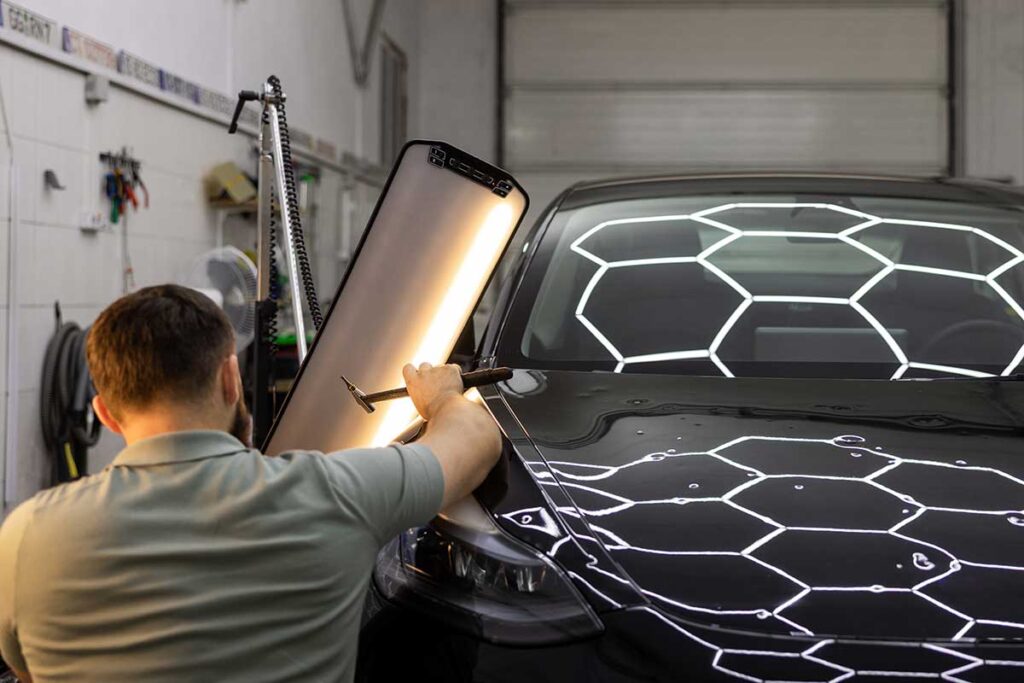
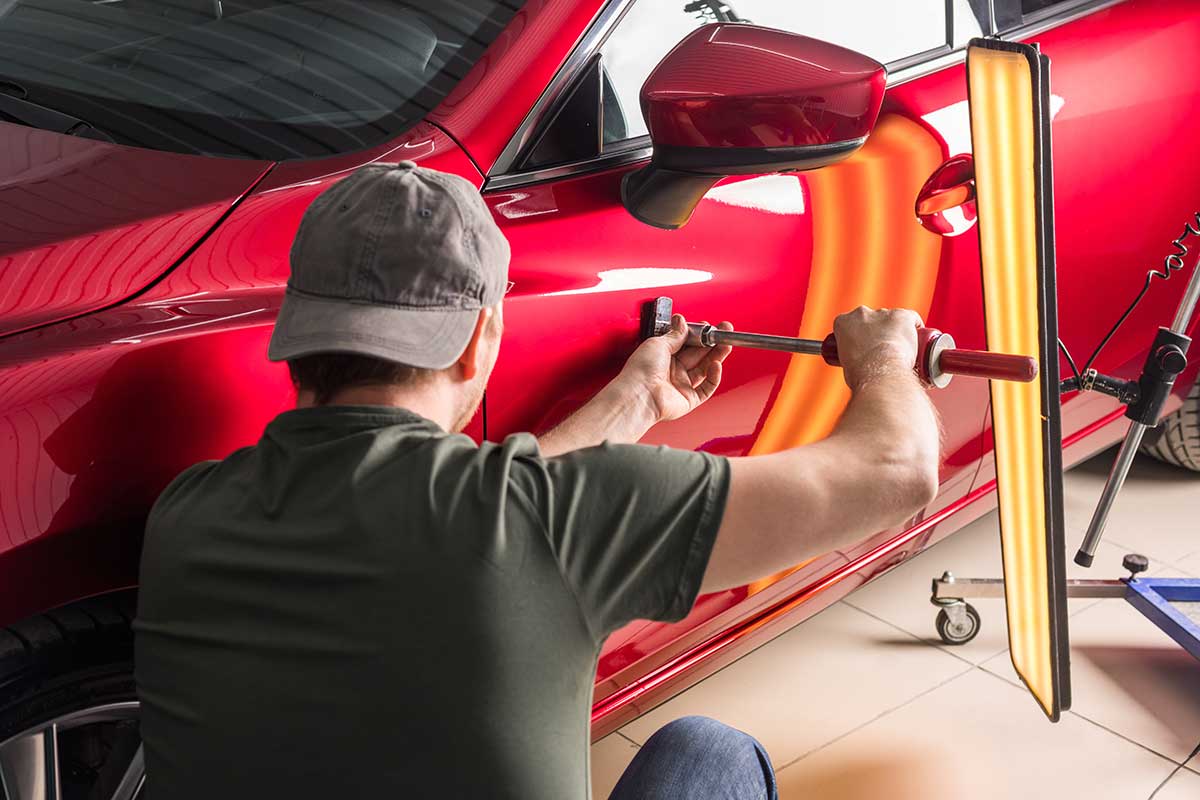
Good lighting is one of the most useful parts of dent repair because a smooth reflection reveals changes in the panel’s shape. A dent may appear corrected when viewed straight on but remain visible when the vehicle is viewed from the side.
A practical inspection setup includes:
- Bright, even light rather than a dark garage
- A straight reflection across the damaged area
- Several viewing angles
- A clean, dry panel
- Enough space to move around the vehicle
A reflection board or a long strip of contrasting light can make low and high areas easier to see. The repair should be checked repeatedly, not only at the end. Stopping early is often safer than continuing after the main low spot has improved.
What are the most common DIY mistakes?
The most common mistake is applying too much force too quickly. Automotive panels are thin and shaped, so a strong push does not always move only the center of the dent. It can distort nearby metal and create a visible high spot.
Other frequent problems include:
- Working on a dirty panel and scratching the finish
- Using a sharp tool directly against the metal
- Pulling from the wrong location
- Heating the panel excessively
- Removing trim without knowing how it is secured
- Ignoring paint cracks that may spread
- Focusing on the deepest point while missing the outer contour
- Continuing after the panel begins to develop a raised area
A metal pick, screwdriver, or improvised tool can concentrate force too aggressively. Even when the paint remains intact, a small tool mark may permanently change the reflection.
Can a DIY repair affect safety or resale value?
A small cosmetic dent usually does not affect vehicle safety, but the repair process can create safety concerns if it involves structural areas, door reinforcements, airbags, sensors, or electrical components. Removing interior door panels without understanding their contents can be hazardous.
Resale value is also influenced by repair quality. A nearly invisible repair may have little practical effect, while a panel with obvious waves, cracked paint, or an unfinished appearance may attract more concern than the original dent.
If a vehicle is leased, insured under a policy with specific repair requirements, or being prepared for sale, documentation and repair standards may matter. It is wise to check the applicable agreement or policy before altering the panel.
How should someone decide whether to try?
A simple decision test is useful:
- Try only if: the dent is small, shallow, paint-safe, away from edges, and accessible.
- Pause and reassess if: the dent is near a body line, sensor, seam, or airbag.
- Avoid DIY repair if: the paint is cracked, the metal is sharply creased, or the panel has already been repaired.
- Stop immediately if: a high spot forms, paint begins lifting, or the panel makes unusual cracking sounds.
The cost of a tool kit is not the only consideration. The real cost includes the possibility of needing additional repair if the panel is overworked. For a minor dent on an older vehicle, a careful DIY attempt may be reasonable. For a newer vehicle, a visible body line, metallic paint, or a panel with safety equipment behind it, preserving the original condition may be more valuable than experimenting.
What is the practical answer for Apex residents?
DIY paintless dent repair is worth considering for limited cosmetic damage, but it is not a reliable solution for every dent. The best candidates are shallow, paint-intact dents in open areas of a panel where the movement can be observed clearly.
Local conditions can influence the decision. Outdoor repairs may be complicated by pollen, dust, direct sun, humidity, or rapidly changing temperatures. Vehicles parked outside near mature trees may also experience repeated minor impacts from branches or falling debris. A clean, shaded, temperature-controlled workspace makes inspection and controlled repair easier.
The safest mindset is to treat the process as gradual metal shaping, not forceful dent removal. If the damage involves a crease, edge, structural seam, safety component, or previously repaired paint, avoiding experimentation is usually the more sensible choice.