

 See My Latest Article on HelloNation
What makes a paintless dent repair technician reliable?
A reliable Paintless Dent Repair (PDR) technician is someone who can accurately assess the damage, explain the repair limits, protect the vehicle during the work, and provide a realistic result without making exaggerated promises.
PDR is a specialized method that restores a vehicle’s original metal by carefully accessing the back of a dent and reshaping the panel with controlled pressure. Because the factory paint remains in place, the process can preserve the original finish when the damage is suitable and the technician has the necessary skill.
The quality of the result depends less on how quickly a dent can be pushed out and more on how well the technician reads the metal, identifies the original contours, and avoids stretching or overcorrecting the panel.
How can a vehicle owner tell whether a dent is suitable for PDR?
A trustworthy technician should inspect the damage before recommending a repair method. PDR is often appropriate for shallow or moderately deep dents where the paint is intact and the metal has not been sharply torn.
Useful questions include:
- Is the paint cracked, chipped, or peeling?
- Is the dent located near a panel edge, body crease, brace, or structural seam?
- Has the metal been stretched?
- Can the back of the damaged area be reached safely?
- Is the panel made from steel, aluminum, or another material?
- Does the dent affect a sensor, camera, light, or other safety-related component?
A small dent is not automatically an easy dent. A shallow door ding in an open section of a panel may be straightforward, while a similar-looking dent near a sharp character line can require more time and precision.
A reliable assessment may conclude that PDR is not suitable. That is not a failure of the process. It may indicate that conventional body repair, panel replacement, or further inspection is safer and more appropriate.
What experience matters in PDR?
Experience should be specific to paintless dent repair rather than limited to general automotive work. PDR requires specialized tools, lighting, hand control, and an understanding of how different panels respond to pressure.
Technicians may work on steel and aluminum panels, but the materials do not behave identically. Aluminum can be less forgiving and may require different techniques. Modern vehicles may also include reinforced areas, glued components, advanced driver-assistance systems, and complex trim that complicate access.
Rather than relying only on a claim such as “many years in business,” ask how the technician handles:
- Aluminum panels
- Sharp body lines
- Creases and crowns
- Hail damage
- Dents near bracing or edges
- Paint that has already been refinished
- Vehicles with parking sensors or cameras
The answers should be clear and practical. A technician who discusses limitations openly is generally easier to trust than one who treats every dent as identical.
Why does the inspection process matter?
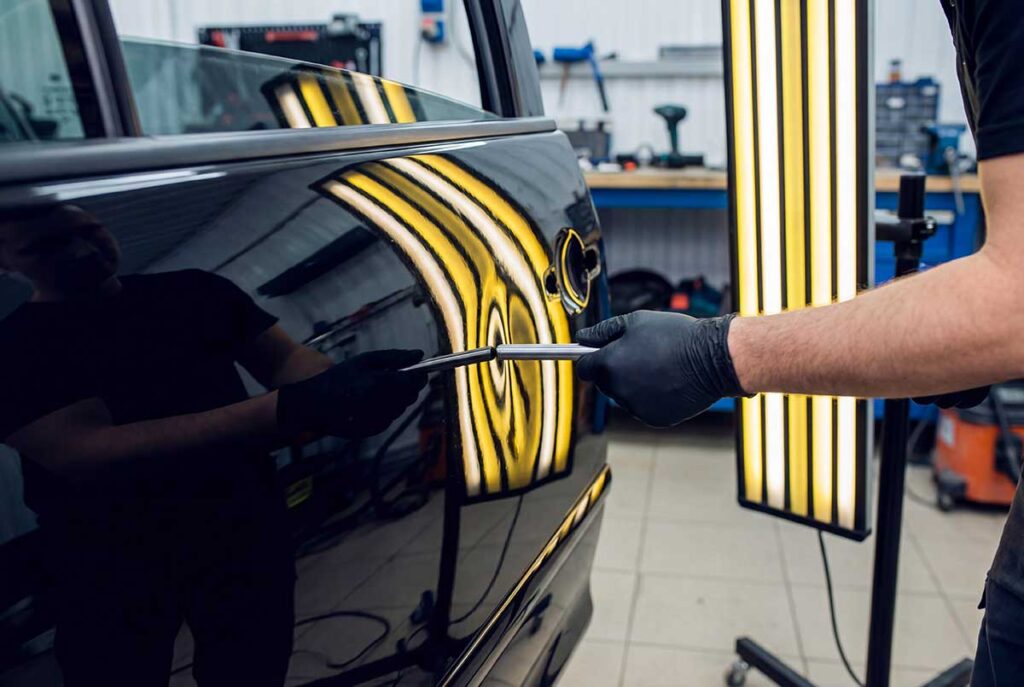
A careful inspection helps prevent incorrect expectations. Before work begins, the damaged panel should be viewed from several angles, usually with specialized reflection lighting. This allows the technician to see low spots, high spots, stretched metal, and subtle ripples that may not be visible in ordinary daylight.
The inspection should also consider the surrounding area. A dent may have a larger impact zone than its visible center suggests. Removing interior trim, a wheel-well liner, a headliner, or another component may be necessary to reach the back of the panel. Those steps should be explained before repair begins.
Photos can help document the vehicle’s condition, especially if there are nearby scratches, previous repairs, or unrelated dents. Clear documentation reduces confusion about what the repair is intended to address.
What questions should be asked before authorizing the repair?
A short conversation can reveal whether expectations are being handled responsibly. Useful questions include:
- Is the original paint intact?
- What makes this dent a good or poor candidate for PDR?
- Will any trim or interior panels need to be removed?
- Could the repair leave a visible change in the panel?
- Is the vehicle’s paint original or previously refinished?
- How will nearby sensors, wiring, and trim be protected?
- What happens if the damage is deeper than it first appeared?
- Will the technician explain any limitations before starting?
A dependable answer does not have to guarantee perfection. Metal may retain a faint reflection change, especially after a severe impact, a sharp crease, or an older repair. Honest communication about likely results is more useful than an absolute promise.
How can workmanship and vehicle protection be evaluated?
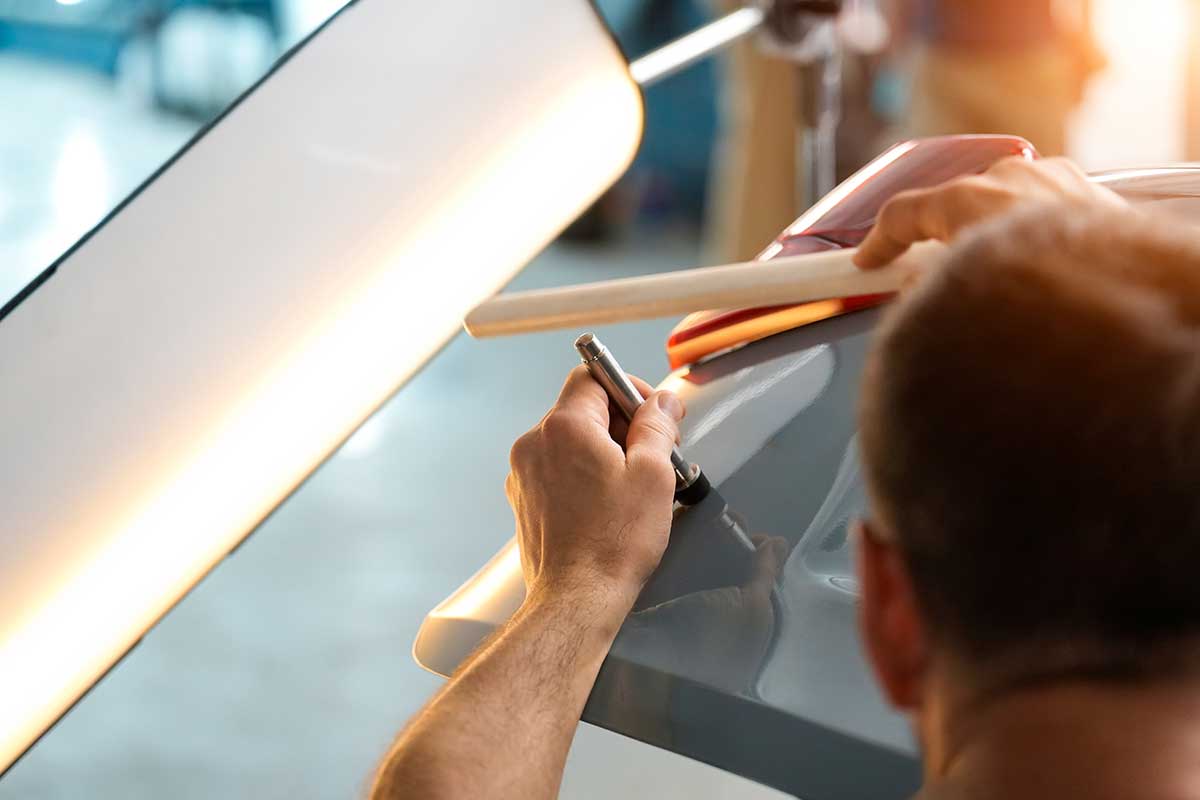
Good PDR work should be performed in a clean, controlled setting with appropriate lighting and tools. The technician should use protective coverings where needed and handle trim, fasteners, and interior components carefully.
After the repair, inspect the panel in different lighting and from multiple angles. Look for:
- Remaining low spots or raised areas
- Unwanted ripples around the original dent
- Distortion along a body line
- Scratches, tool marks, or damage to adjacent trim
- Misaligned panels or improperly refitted components
Not every reflection change is evidence of poor workmanship. Some panels have natural contours that can look different depending on the viewing angle. A proper inspection should distinguish between the vehicle’s original design and an actual repair defect.
Are online reviews enough to choose a technician?
Reviews can provide useful clues, but they should not be the only basis for a decision. Look for detailed comments about inspection quality, communication, cleanliness, finished results, and how unusual or difficult damage was handled.
Be cautious of reviews that focus only on low prices or speed. A fast repair may be appropriate for a simple door ding, but complicated damage requires careful assessment. Photos can also be helpful, although edited, heavily filtered, or poorly lit images may not show the final surface accurately.
A technician’s willingness to explain the process is often more informative than a large collection of brief ratings.
What local conditions can affect dent repair in Apex?
Seasonal weather and daily driving conditions can influence how vehicle damage develops and how repairs are performed. Strong storms can produce hail damage, while falling branches, loose outdoor objects, and crowded parking areas can create isolated dents.
Heat and direct sunlight can also make a damaged panel appear different throughout the day. A dent may be easier to see under angled inspection lighting than in a shaded driveway. During warm weather, interior trim and adhesives may respond differently during removal, so careful handling remains important.
The area’s mix of newer construction, established neighborhoods, commuting traffic, and outdoor parking means vehicles may experience different types of low-speed impacts. That makes a proper inspection more valuable than relying on the dent’s size alone.
When should PDR not be the first choice?
PDR may not be appropriate when the paint is broken, the panel is badly stretched, the metal is torn, or the damage affects structural components. It may also be unsuitable if access to the back of the panel would require unsafe disassembly.
Damage involving headlights, cameras, parking sensors, door operation, hood latches, or other safety-related systems deserves additional care. A cosmetic repair should not hide a mechanical or structural problem.
The most reliable technician is not necessarily the person who agrees to perform the repair. It is the person who can explain what the panel needs, identify the risks, and recommend a different repair path when PDR would produce an unreliable result.